
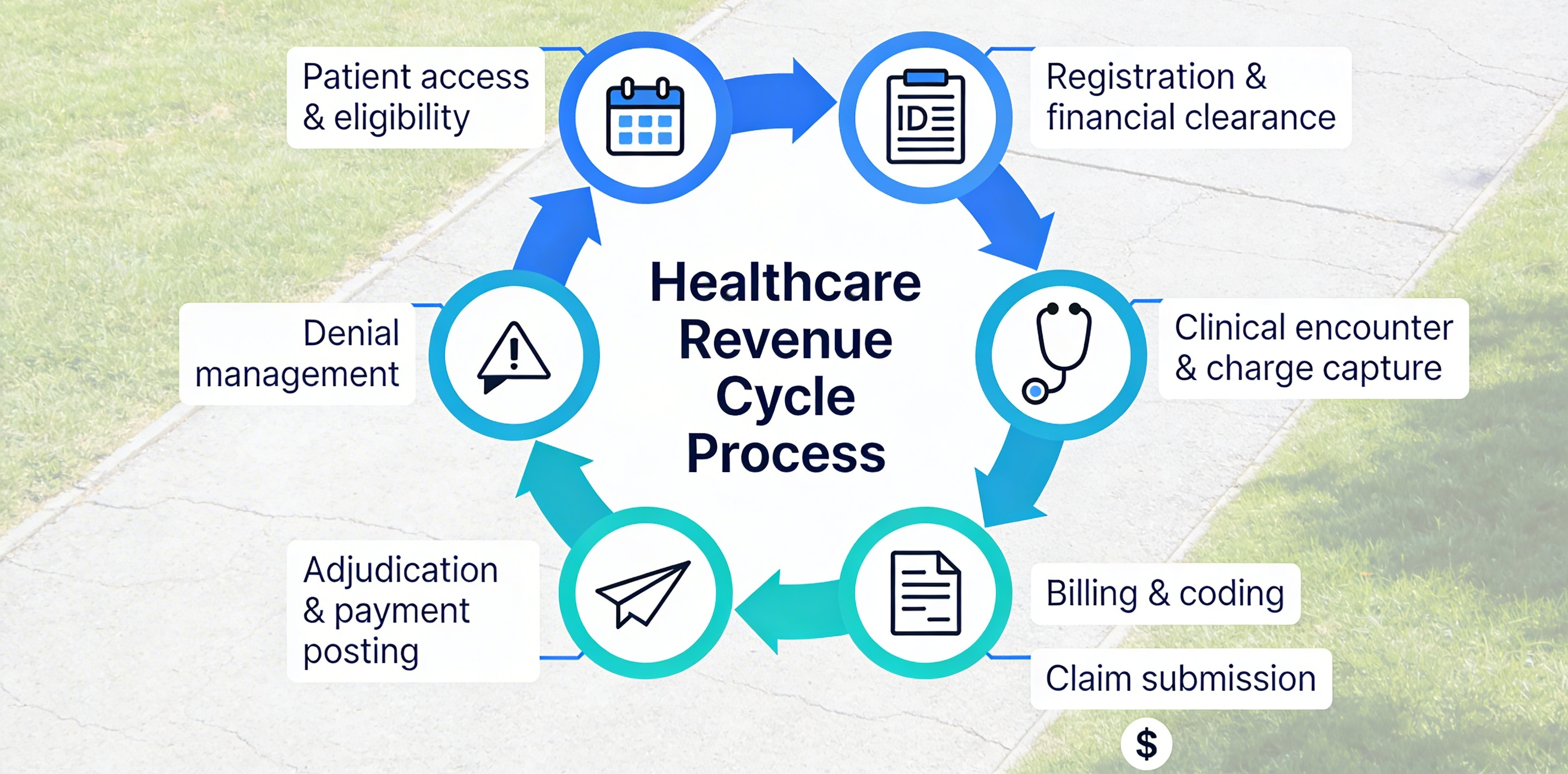
Understanding Revenue Cycle Management (RCM) in Healthcare
RCM

Understanding Revenue Cycle Management (RCM) in Healthcare

March 11, 2026
9 min read
Back to All Articles
Category:RCM

Revenue Cycle Management (RCM) connects clinical care to financial outcomes in healthcare. Learn how the healthcare revenue cycle works and why it is critical for providers and payers.

Revenue Cycle Management (RCM) is the financial engine behind every healthcare organization. While doctors and nurses focus on delivering care, RCM ensures that every service provided is accurately documented, billed, and reimbursed. It connects clinical work with financial outcomes and ensures providers get paid correctly and on time. RCM begins the moment a patient schedules an appointment and continues until the balance for that visit is fully resolved. The process includes patient access, insurance verification, charge capture, medical coding, claim submission, payment posting, denial management, and patient collections. The healthcare revenue cycle starts with pre-visit eligibility verification where staff confirm insurance coverage and authorization requirements. Accurate verification at this stage prevents many downstream denials. During registration, patient information and financial responsibility are confirmed. Providers can discuss deductibles, copayments, and expected costs with patients to avoid confusion later. Once care is delivered, charge capture converts clinical documentation into billable services. Medical coders translate diagnoses and procedures into standardized codes so payers understand what services were performed and why they were medically necessary. After coding, claims are created and submitted to payers. Clean claims pass through automated edits and payer rules to reduce rejections. Once submitted, payers adjudicate the claim and determine reimbursement based on policy benefits and contract terms. If claims are denied or underpaid, denial management teams analyze the root cause, correct errors, and submit appeals when necessary. Finally, any remaining balance is billed to the patient with clear statements and flexible payment options. Effective RCM improves financial stability for providers, reduces administrative friction for payers, and improves the patient experience. With modern RCM software, healthcare organizations can automate eligibility checks, claim edits, payment posting, and analytics to improve efficiency and reduce revenue leakage. For healthcare organizations, optimizing the revenue cycle requires strong front-end processes, accurate clinical documentation, denial prevention strategies, clear patient communication, and data-driven decision making. When providers treat RCM as a strategic function supported by the right technology, processes, and expertise, both providers and payers benefit while patients experience a smoother journey from appointment to final payment.

Key Takeaways

✓ Process Optimization

Streamline your revenue cycle management for maximum efficiency.

✓ Compliance & Accuracy

Stay compliant with industry standards and reduce billing errors.

Why This Matters

Revenue cycle management is not just about billing; it's about the entire lifecycle of a patient account. From the moment an appointment is scheduled to the final payment, every step matters. Errors in the front office can lead to denials in the back office, affecting your practice's financial health.

Conclusion

Implementing these strategies takes time and dedication, but the payoff is substantial. Financial stability allows you to invest back into your practice, improve staff quality of life, and ultimately provide better care for your patients. Start with small, manageable improvements and build from there.

Related Topics